Most cricket clubs run on two apps: one for the admin — scheduling, availability, fees — and one for the scoring. Every week the same handoff breaks in the same places. The roster in the scoring app is out of date. The XI published on Thursday has to be re-typed into the scorer on Saturday. And after the match, the result goes into one app, the stats live in the other, and nobody's records agree.
That is the two-app tax. It is small every week and enormous over a season.
1. The two-app tax, week by week
It starts on Monday, when you post the fixture and ask who can play. By Thursday you are chasing the seven people who have not replied. On Friday you publish the XI. On Saturday you open the scoring app, re-enter the team — because it has its own roster — and score the match. On Sunday someone asks for the season stats, and you realise the scoring app has the runs and the club app has the availability, and the two have never met.
None of this is anyone's fault. Scoring apps were built to score. Club apps were built to manage. But the club is one thing, and splitting it across two systems means the captain becomes the integration layer — copying names between apps, re-entering results, and answering "what's the score?" in the group chat because the live link lives somewhere the supporters never look.
2. What "one app" actually means
One app does not mean one more app. It means the roster, the event, and the scorecard are the same thing, in the same place.
It works like this. The fixture goes up, players RSVP, and the admin nudges only the non-responders. The XI is published from the squad — the same squad that answered the RSVP. On match day the scorer opens the same event, picks the XI that is already there, and scores ball by ball. The live link goes out to supporters. When the match ends, the result is already in the club's record: the stats, the player averages, the season standings — no re-entry, because there was never a second copy.
The test is simple: how many times does a player's name get typed between Monday and Sunday? In a two-app club, at least three. In one app, zero after the first time they join.
3. The live scoring itself
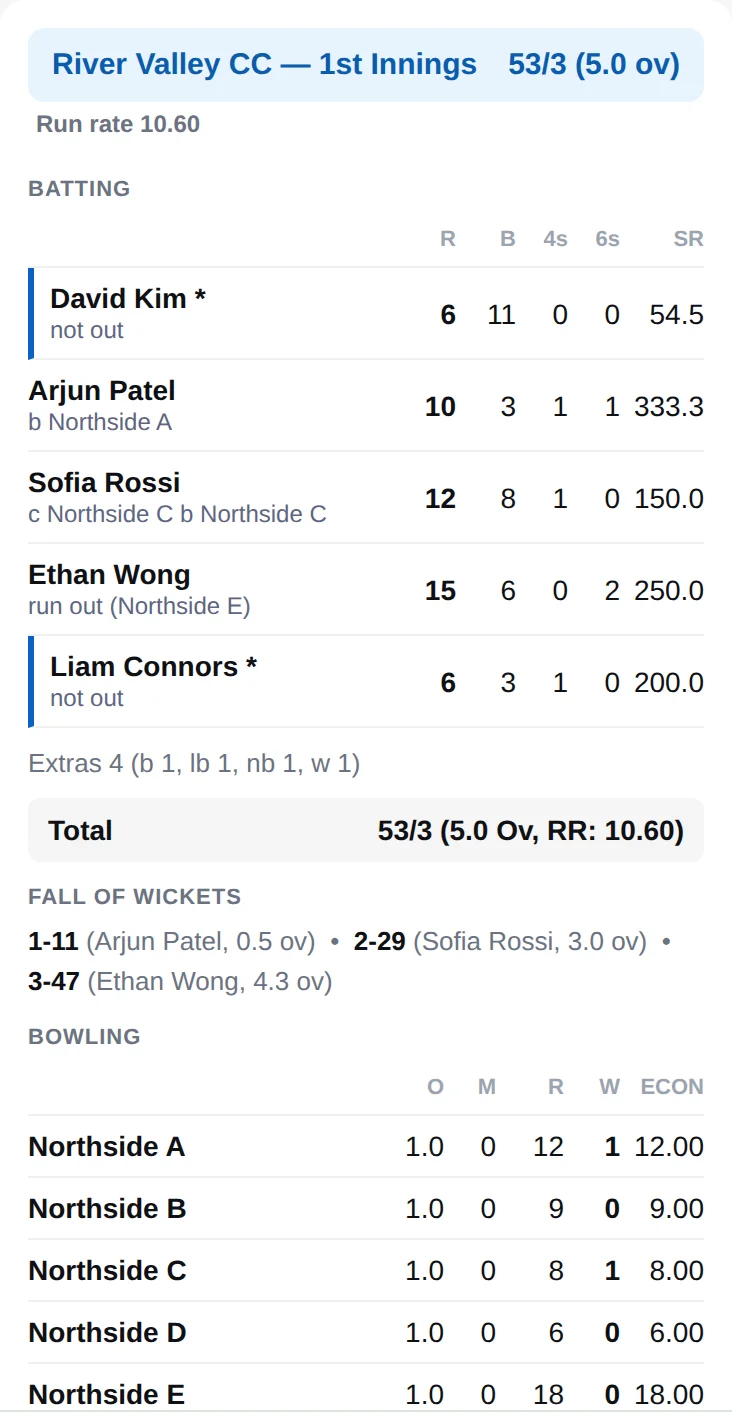
Live scoring is the part supporters actually see, so it has to be good. Aatago scores ball by ball — runs, wickets, wides, no-balls, byes and leg-byes — with a public link anyone can open in a browser, no account needed. The scorecard shows both innings in full: batting figures with strike rates, bowling figures with economy, extras, fall of wickets, and the chase — runs needed, balls left, required rate.
Behind the scorecard, the match builds its own story: partnerships, a Manhattan chart of runs per over, a worm chart tracking both innings, and a short auto-commentary of the key moments. When the match ends, the app suggests a Player of the Match from the numbers, and the admin confirms it.
Scoring is a team-admin job, and any team admin can take over mid-match if the scorer's phone dies. And if the rain comes, the overs can be reduced mid-match — the target recalculates, and the chase card updates with it.
4. What one app does not do
Honesty matters here, so here is the line. Live ball-by-ball scoring is cricket only — pickleball and badminton matches are entered after the game, which suits how those matches run. Aatago tracks dues and reminds the people who owe, but it does not process payments. And if your league runs on another scoring platform and your players' histories live there, keep it — one app is the simpler choice for a club starting fresh, not a reason to rip out something that works.
5. The Saturday test
The proof is one match. Run a fixture through it and see how Saturday feels.
Set the fixture, send the RSVP, and let the nudge do the Thursday chasing. Publish the XI on Friday. On Saturday, score the match live from the published XI, and send the public link to the group chat instead of posting score updates by hand. After the match, check the stats — they are already there.
If Saturday feels calmer, roll it out to the rest of the club. If it does not, you have lost one match's worth of trying, and the free plan costs nothing either way.
The line, in one sentence: the roster, the RSVP, the XI, the live score, and the season stats are one story — and a club should not need two apps to tell it.
What Aatago does, and does not do, here
Aatago handles scheduling, RSVP and availability, nudges to non-responders, published XI, live ball-by-ball cricket scoring with a public spectator link, results, stats and club leaders, dues tracking, waivers, polls, and team chat and announcements, all in one place for a club. It does not process dues payments. It tracks dues and reminds only the people who owe, and players see only their own dues. Players never pay for Aatago. Only clubs pay: Free for 1 team and up to 20 players, Team CA$13/month (US$10/month), Club CA$27/month (US$20/month), with a 30-day free trial and no card required to start.
Next step: Try it for one team for one month — one fixture, one live-scored match, one calmer Saturday. See also: CricHeroes vs a club management app: scoring is only half the job.