Pickleball groups kept asking for the same thing cricket clubs needed — and the first thing they asked about was the ladder. A ladder is the simplest way to keep a casual group competitive without turning it into a league with fixtures, standings meetings, and one exhausted organiser.
Here is how to run one that actually survives past the first month.
1. What a ladder is, and why it beats a fixed league
A ladder is a ranked list of players. You challenge someone above you, you play, and if you win, you take their spot (or move up a rung). Nobody needs to be available on the same night, nobody waits for a fixture list, and a new player can join mid-season without breaking anything.
A fixed league works when the same people show up every week at the same time. Most casual pickleball groups are not that. People travel, work shifts, get injured, and bring a friend one week and not the next. A ladder absorbs all of that. The ranking is the schedule.
2. Setting it up: players, divisions, and challenge rules
Start with the player pool. Eight players is the practical minimum — fewer than that and everyone has played everyone within two weeks. Twelve to forty is the sweet spot for a casual group: enough variety that challenges feel fresh, small enough that everyone knows each other.
Divisions are optional. One ladder for the whole group is simpler and better for most groups under 30 players. Split into divisions only when the skill gap is so wide that the bottom half never challenges the top half — and even then, two divisions is enough. Three or more and you spend more time managing divisions than playing.
Challenge rules need to be written down before the first match. The usual shape: you may challenge anyone up to three rungs above you. The challenged player has one week to accept and play. The winner takes the higher spot (or the two swap). Keep it to three sentences — if your rules need a PDF, they are too complicated.
3. How rankings work: points vs ratings
There are two ways to rank a ladder, and the choice matters more than most organisers think.
Points. Win a match, get points. Lose, get none (or fewer). Simple to explain, but it rewards playing a lot over playing well — the player who shows up four times a week climbs past the better player who shows up once.
Ratings. Every player starts at the same rating — 1000 is the usual starting point — and each match moves both ratings. Beat someone rated higher than you and you gain more; lose to someone rated lower and you drop more. It is the same idea as chess Elo ratings, and it is fairer because it weighs who you beat, not just how often you play.
For a casual group, ratings are the better default. They self-correct: a new player who is actually strong climbs fast, and a rusty regular drops to where their games are competitive again. That is the whole point of a ladder — games that are close.
4. Scoring formats that fit a session
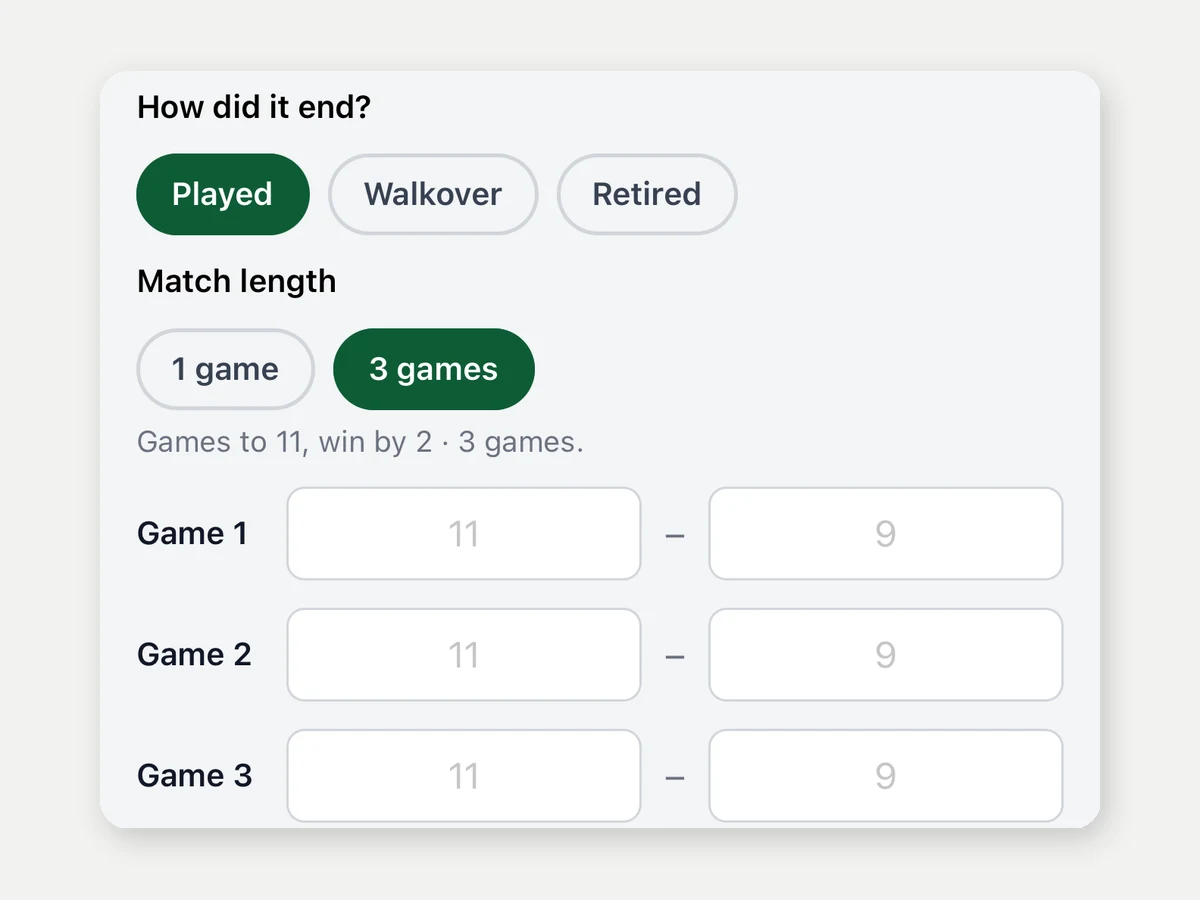
The standard pickleball match is best-of-3 games to 11, win by 2. That takes 30 to 45 minutes for a doubles match, which fits a two-hour session with court rotation.
When courts are tight or the group is large, a single game to 15 or 21 keeps things moving. One game, one winner, next pair on. Pick one format for the ladder and stick to it for the season — mixing formats makes the rankings meaningless, because a single-game win and a best-of-3 win are not the same achievement.
Doubles is the default for most groups. If you run singles too, keep separate rankings. A singles rating and a doubles rating measure different things, and combining them punishes everyone.
5. Disputes and no-shows: decide the rule before you need it
Two things will happen, guaranteed: someone will disagree about a score, and someone will not show up for a challenge. Decide what happens now, while everyone is calm.
Disputes. Scores are entered after the match, so give the losing side a short window to dispute — 48 hours is fair. A disputed score stays flagged until the organiser confirms or voids it. The key is that the dispute is visible to everyone, not a private argument in a group chat.
No-shows. A challenge that is not played by the deadline is a forfeit, and the challenger moves up. No exceptions for the first offence is too harsh; no consequence at all kills the ladder, because nobody bothers to schedule. One free pass per season, then forfeits count. Write it down.
6. The mistakes that kill ladders
Most ladders die the same way, and it is rarely the players' fault.
Too many divisions. Four divisions of six players each is four tiny ladders that never interact. Start with one.
No deadline for challenges. An open-ended challenge is a challenge that never happens. One week, then forfeit.
One person doing all the admin. If the organiser is the only one who can update the rankings, enter scores, and resolve disputes, the ladder dies the week they go on holiday. The system has to let players enter their own scores.
No season end. A ladder that runs forever gets stale — the top stops changing and the bottom stops caring. Run seasons of 8 to 12 weeks, crown a winner, then reset the standings (ratings can carry over, softened toward the middle, so nobody starts from zero).
7. How Aatago runs a pickleball ladder
Aatago's pickleball ladder is built for exactly this shape of group. Players enter their own scores after a match — singles or doubles, best-of-3 or single game to 15 or 21. Scores auto-confirm, so the rankings update immediately without the organiser approving every result. Ratings start at 1000 and move Elo-style after each match. Disputes are flagged in the open with a 48-hour window. Seasons archive the standings and soften ratings toward 1000, so the next season starts fresh but not from scratch.
It also handles the rest of the group: scheduling, RSVPs, team chat, polls, and dues tracking. Free for groups up to 20 players; the Ladder plan is CA$19/month (US$15) flat for 21 to 100 players. Players never pay — only the group subscribes.
The ladder in one season: Week 1, everyone joins and starts at 1000. Weeks 2–10, players challenge up to three rungs above, enter their own scores, and the ratings sort themselves out. Week 11, the season ends, the top of the ladder gets bragging rights, and the next season starts with ratings softened toward the middle. The organiser's job is writing the rules once — not updating a spreadsheet every week.
What Aatago does, and does not do, here
Aatago handles ladder rankings and ratings, score entry, disputes, seasons, scheduling, RSVPs, team chat, polls, and dues tracking for a pickleball group. It does not do court booking or tournament draws, and it does not submit results to DUPR or any federation. Scores are entered after the match — there is no live point-by-point scoring for racquet sports, because a 20-minute match does not need it. Free for groups up to 20 players; Ladder is CA$19/month (US$15/month) flat for 21 to 100 players.
Next step: Set up your group, invite your players, and run one season. Write three challenge rules, pick a scoring format, and let the ratings do the rest. See also: How to run badminton group sessions without the spreadsheet.