A badminton group session looks simple from the outside: book courts, show up, play. But someone has to know who is coming, pair the doubles, sort the court rotation, and collect the money. And that someone is usually doing it in a spreadsheet and a group chat, every single week.
It does not need to be that hard. Here is how to run sessions that organise themselves.
1. The weekly session problem, stated plainly
Every session has the same four questions: who is coming, how many courts do we need, who plays with whom, and who pays what. Answer those four and the session runs itself. Miss any one of them and the organiser spends the first twenty minutes on court sorting it out instead of playing.
The usual setup — a group chat for availability, a spreadsheet for pairings, and a mental note for who owes court fees — works until the group passes about twelve people. Then the chat buries the answers, the spreadsheet is out of date, and the same two people end up paying for everyone else. The fix is not more effort. It is one place where the answers live.
2. Set a regular schedule and an RSVP deadline
Same day, same time, same courts, every week. Regularity is the single biggest admin saver there is — players build it into their week and you stop negotiating the schedule from scratch every Monday.
Then set an RSVP deadline. 48 hours before the session is enough: it gives you time to confirm the court booking, sort the pairings, and offer a spot to the waitlist if someone drops out. One deadline, visible to everyone, and the rule is simple — if you have not replied by the deadline, you do not have a spot. Chasing only the non-responders, instead of messaging the whole group again, is what keeps it from feeling like nagging.
3. Pairing doubles: mix levels, rotate partners
The pairing question is where most groups quietly lose players. If the same strong pair always plays together, the games are lopsided and the developing players stop coming. If pairings are random every week, nobody builds a partnership.
The pattern that works: rotate partners each game and mix the levels. Pair a stronger player with a developing player, and match the pairs against each other so the games are close. Over a session, everyone plays with two or three different partners. Over a season, everyone plays with everyone.
Ladder rankings make this easier, not harder. When you know roughly where everyone sits, you can pair a top-half player with a bottom-half player and get a competitive game without guessing. The ranking is a guide for pairings, not a judgement.
4. Track who has played whom
In a group of twenty, it is easy to play the same four people every week and never meet the rest. That is how a group splits into cliques without anyone noticing.
Keeping a record of matches — even just who played whom — tells you who has not played together yet. Rotate deliberately: if two players have never been partners, pair them next session. It keeps the group social, and it keeps the games fresh. A ladder does this naturally, because the rankings push players toward opponents they have not faced.
5. Collecting session fees and court costs
Courts cost money, and someone has to collect it. The fair way is to split the booking evenly across the players who attended that session — not across the whole group, and not whoever happens to have cash on them.
The part that breaks is the tracking. "You owe me from last week" works for one week. By week four, nobody remembers who paid what. Track dues per session, per player, and remind only the people who owe. Players should see only their own balance — nobody needs to see everyone else's. And the money itself stays between the players and whoever books the courts; the app tracks it, it does not process it.
6. Dropouts and waitlists
Someone will drop out. The question is whether their spot goes to waste or to the next person in line.
Set a session cap based on your courts — four players per court per two-hour session is comfortable for doubles, so two courts means eight players, three courts means twelve. When the session is full, further replies go on a waitlist, first in, first out. When someone drops out before the deadline, the first person on the waitlist gets the spot and a notification. No group-chat auction for the free spot, no organiser manually working down a list.
Late dropouts — after the deadline — still owe their share of the court cost. That rule, stated once, cuts late dropouts in half. Courts are booked; the cost does not disappear because someone's plans changed.
7. Keeping it fair over a season
A group that runs for months needs a season shape, or it drifts. Run 8 to 12 weeks, then pause and reset. Standings reset so the next season starts fresh; ratings soften toward the middle so nobody starts from zero but nobody is locked at the top either.
Use the break to check the things that slip: are the same people always sitting out a rotation? Is one court always the "strong" court and the other the "weak" one? Are new players getting games with the regulars, or only with each other? A five-minute look at the season's matches answers all of it.
The session in one week: Monday, the session is posted with the deadline. Wednesday, the deadline passes and the pairings are set from the RSVP list. Thursday, waitlist spots are filled. Saturday, you arrive, the courts are booked, the pairs are set, and the court cost is split across who actually played. The organiser's job is booking the courts — not chasing replies and counting cash.
What Aatago does, and does not do, here
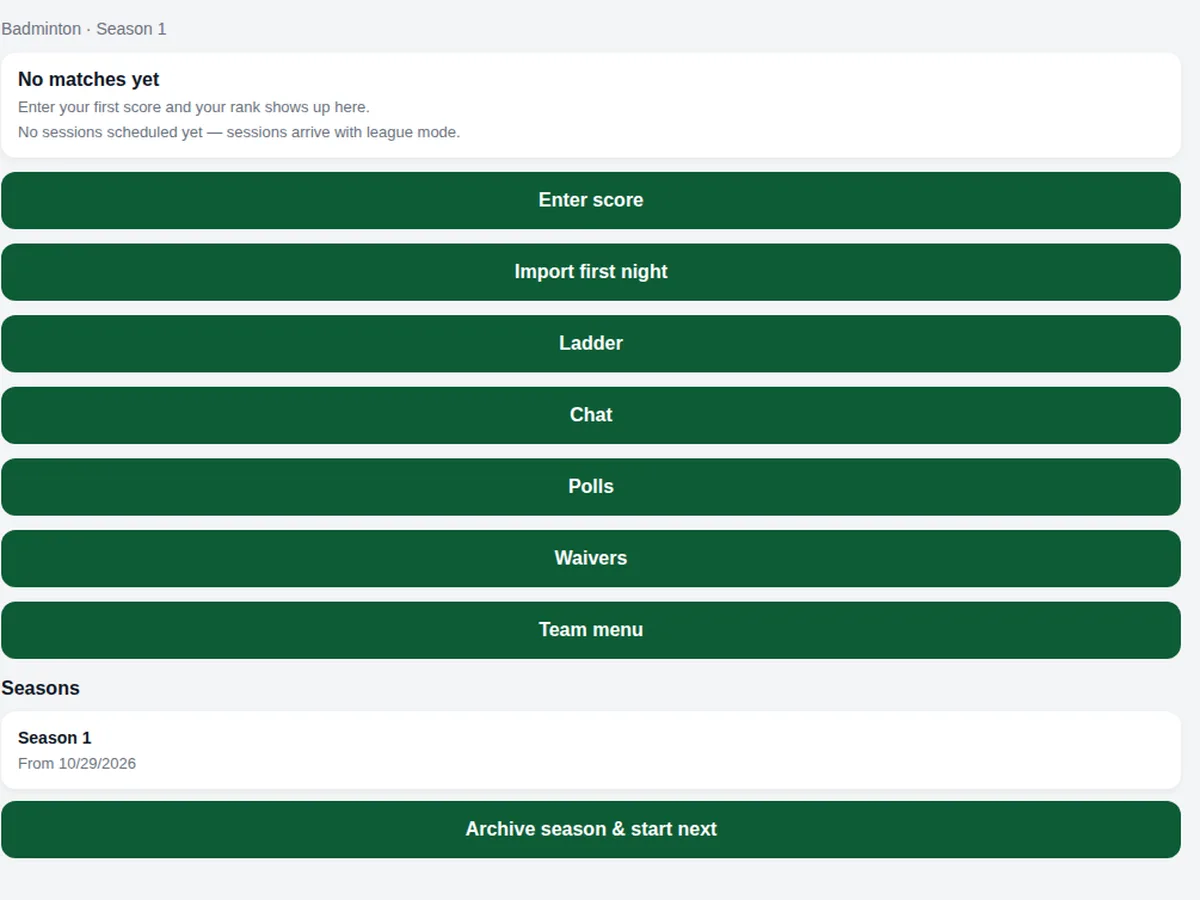
Aatago handles group sessions, scheduling, RSVPs and waitlists, ladder rankings with Elo-style ratings from 1000, score entry after matches, disputes, seasons, dues tracking, polls, and team chat for a badminton group. Badminton runs in league mode, so entered scores stay pending until confirmed — the group agrees the result before the rankings move. It does not do court booking, and it does not do live point-by-point scoring for racquet sports, because a 20-minute match does not need it. Free for groups up to 20 players; Ladder is CA$19/month (US$15/month) flat for 21 to 100 players. Players never pay — only the group subscribes.
Next step: Set up your group, post one session, and set a 48-hour RSVP deadline. If Saturday feels calmer, you have your answer. See also: How to run a pickleball ladder: rules, rankings, and the mistakes to avoid.